
RAG vs. Fine-Tuning vs. AI Agents: Choosing the Right Architecture for Enterprise AI
Explore RAG, fine-tuning, and AI agents to choose the right enterprise AI architecture for scalable, secure, and smarter solutions.
Typical enterprise AI initiatives aim at assisting workers in locating information faster, automating processes or tasks, or making efficient use of business data. However, translating such ideas into a production-quality product requires an additional crucial step – determining the kind of architecture to apply to the AI project.
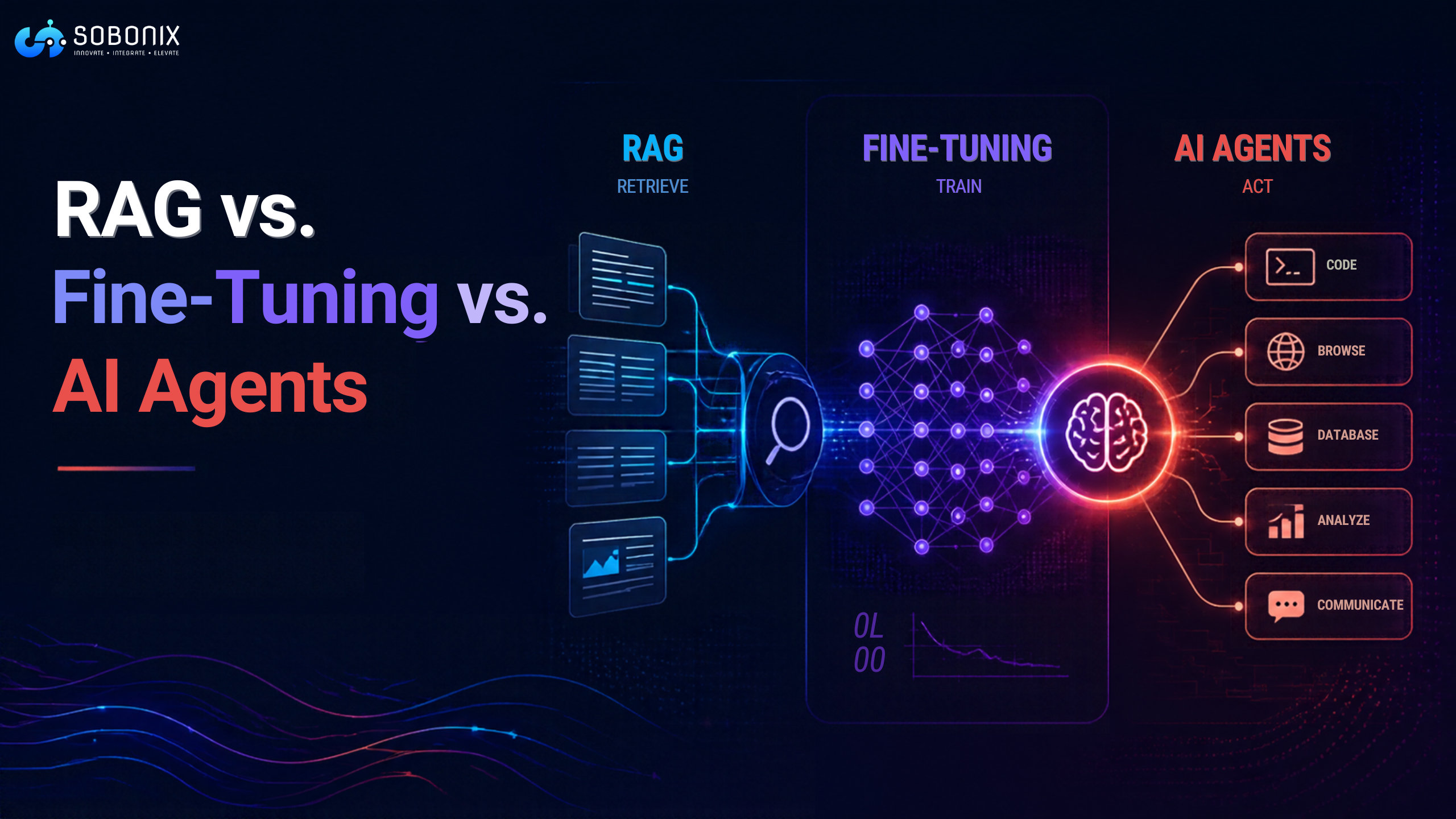
Three types of architectures – retrieval-augmented generation (RAG), fine-tuning, and AI agents – are designed to solve different problems. RAG refers to a combination of a language model and access to relevant external data. Fine-tuning enables the adaptation of a model to a particular task or type of response. AI agents rely on a language model and tools necessary to perform multi-step tasks.
According to the Stanford AI Index Report 2026, based on a McKinsey survey, 88% of surveyed organizations reported using AI in 2025, compared with 78% in 2024. This growing adoption makes the ability to choose and implement the right architecture increasingly important for enterprise technology teams.
This guide compares RAG, fine-tuning, and AI agents, explains where each approach fits, and outlines how businesses can combine them into a reliable enterprise AI solution.
What Is the Difference Between RAG, Fine-Tuning, and AI Agents?
Although these approaches can all improve AI applications, they operate at different levels.
RAG focuses on providing relevant information to a model when it generates a response. Fine-tuning changes the model's behavior through additional training. AI agents introduce a workflow layer that allows a model to use tools, gather information, and perform authorized actions.
Understanding this distinction helps prevent businesses from solving the wrong problem with the wrong technology.
Retrieval-Augmented Generation (RAG): Connecting AI to Business Data
RAG combines information retrieval with generative AI. Instead of relying only on information learned during training, the system retrieves relevant content from an external knowledge source and supplies it to the model when answering a query.
How RAG Works
A typical RAG pipeline follows three main stages:
Retrieve: Search a knowledge base, document repository, or indexed data source for relevant information.
Augment: Add the retrieved content to the model's context.
Generate: Use the model to produce an answer grounded in the available information.
For example, an enterprise software development company might build an internal assistant that answers questions about product documentation, support procedures, and technical policies. RAG allows the assistant to retrieve relevant passages before responding.
The knowledge base can also be updated as documents change without retraining the underlying language model. However, the retrieval index must be refreshed or synchronized appropriately.
When Should Enterprises Use RAG?
RAG is useful when an application needs to work with private, specialized, or frequently changing information.
Common use cases include:
- Enterprise knowledge assistants
- Document search and analysis
- Customer support applications
- Internal policy and compliance queries
- Product documentation assistants
- Research and report generation
Architectural Considerations
RAG performance depends heavily on retrieval quality. Developers need to select suitable embedding models, define document chunking strategies, configure search indexes, and determine how results are ranked.
For enterprise applications, access control is equally important. A user should retrieve only the information they are authorized to view. Tenant permissions, document-level access rules, and data freshness must be enforced throughout the retrieval process.
RAG can improve grounding, but it does not guarantee correct answers. If the system retrieves irrelevant information or misses an important document, the generated response may still be inaccurate.
Fine-Tuning: Adapting a Model to Specific Requirements
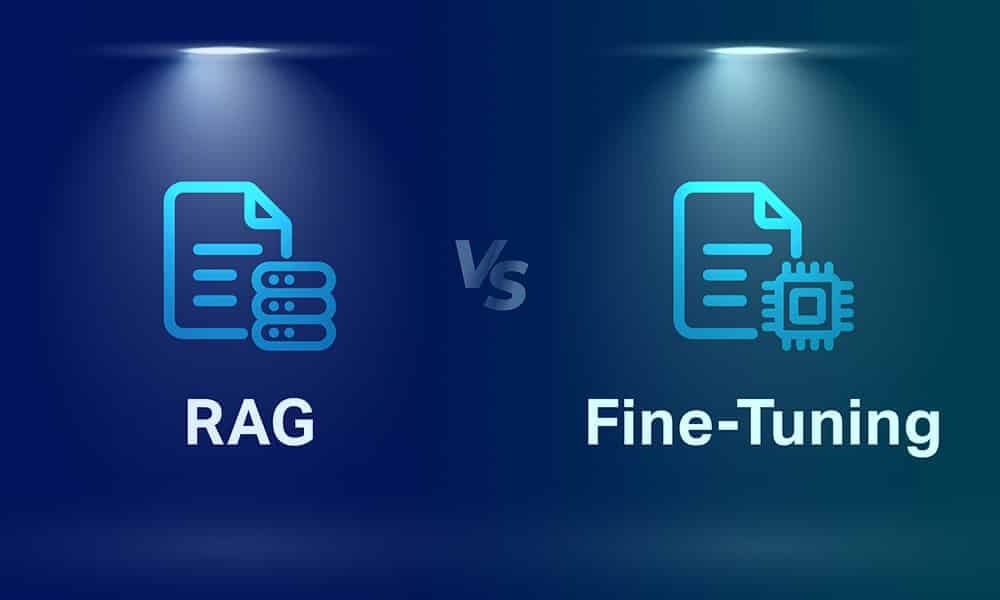
Fine-tuning entails extra training using a specially selected dataset to fine-tune the model to accomplish a specific task, style or behavior. Whereas RAG helps in providing the required information at inference time, fine-tuning adjusts how the model behaves by learning certain things during training. An organization may wish for the AI model to be able to categorize the support tickets in specific ways, generate outputs that fit a certain format, or use a certain language that is typical to the specific domain.
- Fine-tuning might assist the model to perform such operations consistently whenever the right training data is provided.
- Fine-tuning involves additional training on a carefully prepared dataset to adapt a pretrained model to a particular task, style, or behavior.
- While RAG supplies information at inference time, fine-tuning changes how the model responds based on patterns learned during training.
- For example, an enterprise may want an AI model to classify support tickets into specific categories, produce outputs in a consistent format, or follow specialized terminology used in its industry.
- Fine-tuning may help the model perform these tasks more consistently when suitable training examples are available.
When Should Enterprises Use Fine-Tuning?
Fine-tuning can be useful when an enterprise needs:
- Consistent output formats
- Specialized classification or extraction behavior
- Domain-specific terminology
- A particular writing style or tone
- Improved performance on a well-defined task
It is not automatically the best way to give a model access to new business facts. When the main requirement is answering questions about frequently updated documents, RAG is generally a more direct approach.
Architectural Considerations
Fine-tuning requires representative, high-quality training examples and a reliable evaluation process.
The team must prepare the dataset, select an appropriate base model, run training, compare performance against a baseline, and validate the results before deployment.
The model may also need further evaluation or retraining as requirements change. Enterprises should account for training costs, model versioning, deployment requirements, and ongoing performance monitoring.
Fine-tuning can improve task-specific behavior, but it does not guarantee factual accuracy or eliminate the need for security controls.
AI Agents: Connecting Reasoning With Action
AI agents are designed to work toward a goal by using a model to interpret requests, select tools, gather information, and carry out authorized steps.
Unlike a basic model integration that generates a response, an agent can interact with APIs, databases, search services, and enterprise applications.
Consider an IT support workflow. A basic AI assistant might summarize a support ticket and suggest a solution. An AI agent could retrieve relevant troubleshooting documentation, check system status through an approved tool, prepare a response, and create an escalation request if the issue remains unresolved.
The agent's capabilities depend on its tools, permissions, instructions, and orchestration logic.
When Should Enterprises Use AI Agents?
Agents are particularly useful when a task involves multiple steps or requires decisions based on changing context.
Potential applications include:
- IT service management
- Sales and CRM workflows
- Customer support operations
- Report preparation
- Procurement coordination
- Document processing and routing
- Internal business process automation
Architectural Considerations
AI agents require more than a model and a prompt. Their architecture may include an orchestration service, tool interfaces, state management, retrieval services, execution limits, and monitoring.
Security controls are essential because an agent may modify records or initiate business actions. Each tool call should undergo server-side authorization and input validation. Sensitive operations may also require human approval.
Agents can introduce additional latency, model usage, and failure points. For predictable, rule-based tasks, conventional automation may be simpler and more reliable.
RAG vs. Fine-Tuning vs. AI Agents: A Comparison
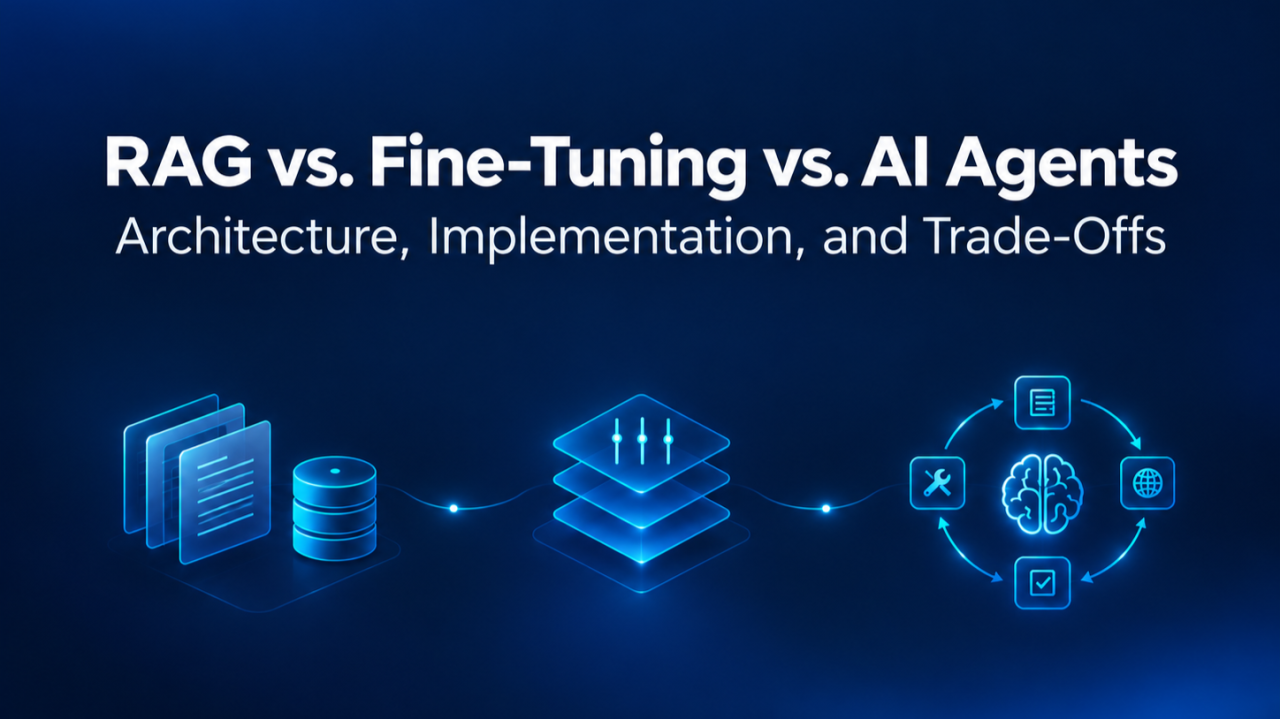
The following table summarizes the main differences.
No single approach is best for every enterprise use case. The decision should be based on the business problem and the operational requirements of the application.
Also Read : How to Integrate AI Into an Existing SaaS Product: RAG, AI Agents, APIs, and Architecture Decisions
How to Choose the Right Architecture for Your Enterprise
Define first what you want your AI system to do before choosing an approach. This framework might help.
Consider Using RAG If Information Accessibility Is the Key Problem
In case employees need responses from internal documents, from product manuals, contract, or up-to-date knowledge bases, begin by analyzing RAG's performance.
The critical question to answer is whether the model needs to have access to some data which might not be present in the initial training dataset.
Consider Fine-Tuning If the Behavior of the Model Should Be Changed
In case the model is supposed to work in some specific format, repeat classification and generate consistent domain-related results, fine-tuning can be used.
In the beginning, figure out if there is any chance to achieve the goal with prompt design, structured outputs or other less demanding ways. There are costs related to fine-tuning.
Consider Using AI Agents If the Action Is Required
In case the system needs to go through a workflow where it needs to retrieve information, call several APIs, make decisions and fulfill some tasks in a row, use agents.
Begin with some limited workflow, well-defined permissions and success criteria. Then scale the responsibilities of an agent only when you are sure
Can Enterprises Combine RAG, Fine-Tuning, and AI Agents?
Yes. These approaches are complementary, and many enterprise web application development can benefit from combining them.
Consider an AI assistant for enterprise customer support.
- RAG retrieves relevant product documentation, troubleshooting guides, and support policies.
- Fine-tuning, where justified, can help the model follow a specialized response format or perform a recurring support classification task.
- An AI agent can use the retrieved information and approved tools to create a ticket, update a record, or escalate an issue.
In this architecture, each component has a distinct responsibility.
A simplified workflow might look like this:
User request → Agent orchestration → RAG retrieval → Model response → Policy validation → Authorized API action → Audit log
Fine-tuning may influence the model's behavior within this flow, but it does not replace retrieval or execution controls.
This combined approach can be useful when an enterprise needs accurate information, consistent outputs, and controlled action in one application. However, additional components also increase complexity, so each should have a clear purpose.
Security, Governance, and Evaluation: What Every Architecture Needs
Regardless of the chosen approach, enterprise software development solutions requires controls that support reliable operation.
Data Security and Access Control
Apply authentication, authorization, and tenant isolation to every relevant data source and tool. AI components should not bypass existing business permissions.
Evaluation and Monitoring
Establish test cases before deployment. Measure answer quality, retrieval relevance, task completion, latency, failure rates, and operating costs. Monitor performance as data, models, and workflows change.
Human Oversight
Require human approval for sensitive or high-impact actions when appropriate. Provide clear escalation paths when the model lacks sufficient information or a tool fails.
Cost and Performance Management
Track model usage, retrieval costs, training expenses, infrastructure consumption, and retries. Use caching, model routing, and execution limits where appropriate.
Auditability
Record important retrievals, tool calls, decisions, and outcomes while protecting sensitive information. Audit trails help teams investigate errors and demonstrate how the application operates.
These controls should be included in the initial architecture rather than treated as optional additions after launch.
Key Takeaways
- RAG connects AI models to relevant business information without requiring the model to learn every new fact through training.
- Fine-tuning adapts model behavior for specialized tasks, output formats, or recurring patterns.
- AI agents use models and tools to complete multi-step workflows within defined permissions.
- RAG, fine-tuning, and agents can be combined when each solves a distinct requirement.
- Retrieval quality, data access controls, evaluation, and monitoring are essential for enterprise AI.
- The best architecture is the simplest one that meets the product's accuracy, security, performance, and business requirements.
Conclusion
Selection among RAG, fine-tuning, and AI coding agents is inherently architectural. Each solves a different problem - access to information, adaptation of model behavior, or task completion using interconnected systems.
Enterprises need to choose from three methods only two, or even just one, in order to develop their AI product. The most important thing is to define the problem correctly, make proper component selection, and have the necessary controls in place.
Once the use case, architecture, and evaluation process are properly defined, businesses will be able to move from AI experimentation stage to actual development of real-world applications.
FAQs
Is RAG better than fine-tuning for enterprise AI?
Neither approach is universally better. RAG is generally more suitable when responses need current or private information. Fine-tuning is useful when the model needs to learn specific response patterns or improve performance on a defined task.
Can AI agents work without RAG?
Yes. An agent can use APIs, structured data, or predefined tools without RAG. However, RAG can help when the agent needs to retrieve relevant information from documents or a knowledge base.
Does fine-tuning eliminate AI hallucinations?
No. Fine-tuning can improve task-specific behavior, but it does not guarantee factual accuracy. Applications may still need retrieval, output validation, monitoring, and human review.
Which architecture is the most cost-effective?
The answer depends on usage volume, model choice, infrastructure, training requirements, and workflow complexity. A direct model API may be enough for a simple task, while RAG or agents may justify their added costs when they solve a specific business problem.
How should enterprises begin implementing AI?
Start with a defined use case, establish baseline performance, and compare suitable architecture options. Build a limited pilot, evaluate results against measurable criteria, and expand after validating reliability, security, and business value.


