
Context Engineering for AI Agents: How It Differs From Prompt Engineering in 2026
Discover how context engineering for AI agents differs from prompt engineering and enables smarter, more reliable AI systems in 2026.
In the current state of development of AI, having a good prompt for the system is not sufficient anymore to get consistent reliable outcomes. With the advent of large language models as the basis for AI agents capable of reasoning, using tools, searching, editing files, performing multi-step actions, the developers have started to have to not only control what they say to the model but also what information the model has access to at each step of operation.
The problem of context engineering for AI agents has come to the fore in 2026. Unlike prompt engineering, which mostly concentrates on creating the instructions, context engineering aims to control the whole information environment around the AI system. In this regard, it decides which instructions, memories, tool output, documents, user information, and intermediate results will be accessible to the model at a certain moment of time.
Anthropic defines context engineering as the process of curation and maintenance of the ideal set of tokens available to the model during inference. Besides, it stresses the limited nature of the context and that providing more data does not mean that better results will be achieved.
That distinction matters because AI agents operate differently from traditional prompt-response applications. An agent may interact with a model dozens of times during one task, continuously accumulating new information. Therefore, the quality of every subsequent decision depends partly on how effectively the system manages that evolving context.
Key Takeaways
- Prompt engineering focuses primarily on improving instructions given to an AI model.
- Context engineering manages the broader information supplied to the model throughout an agent's execution.
- AI agents require context management because they operate across multiple steps, tools, data sources, and states.
- More context does not automatically mean better performance; irrelevant information can introduce noise and reduce reliability.
- Retrieval, memory, summarization, context compaction, tool outputs, and state management are becoming important components of modern AI architecture.
- In 2026, effective AI agent development increasingly requires engineers to treat context as an architectural resource rather than merely a prompt-writing concern.
What Is Context Engineering for AI Agents?
Context engineering for AI agents is the deliberate design, choice, structuring, and management of the information available to an AI model during the execution of the task by the agent.
In the case of a simple chatbot, the context can involve mainly system instructions, user queries, and past conversation history. In the case of an AI agent, however, there can be a more extensive set of information around.
The agent's context can involve:
- System instructions
- User intentions
- Conversation history
- Documents
- Database entries
- Tool descriptions
- API calls
- User preferences
- Memory
- Prior actions
- Intermediary results
- Application state
- Security and permissions data
So context engineering is all about a more general problem of:
Which information does the model need to see right now to make the next decision correctly?
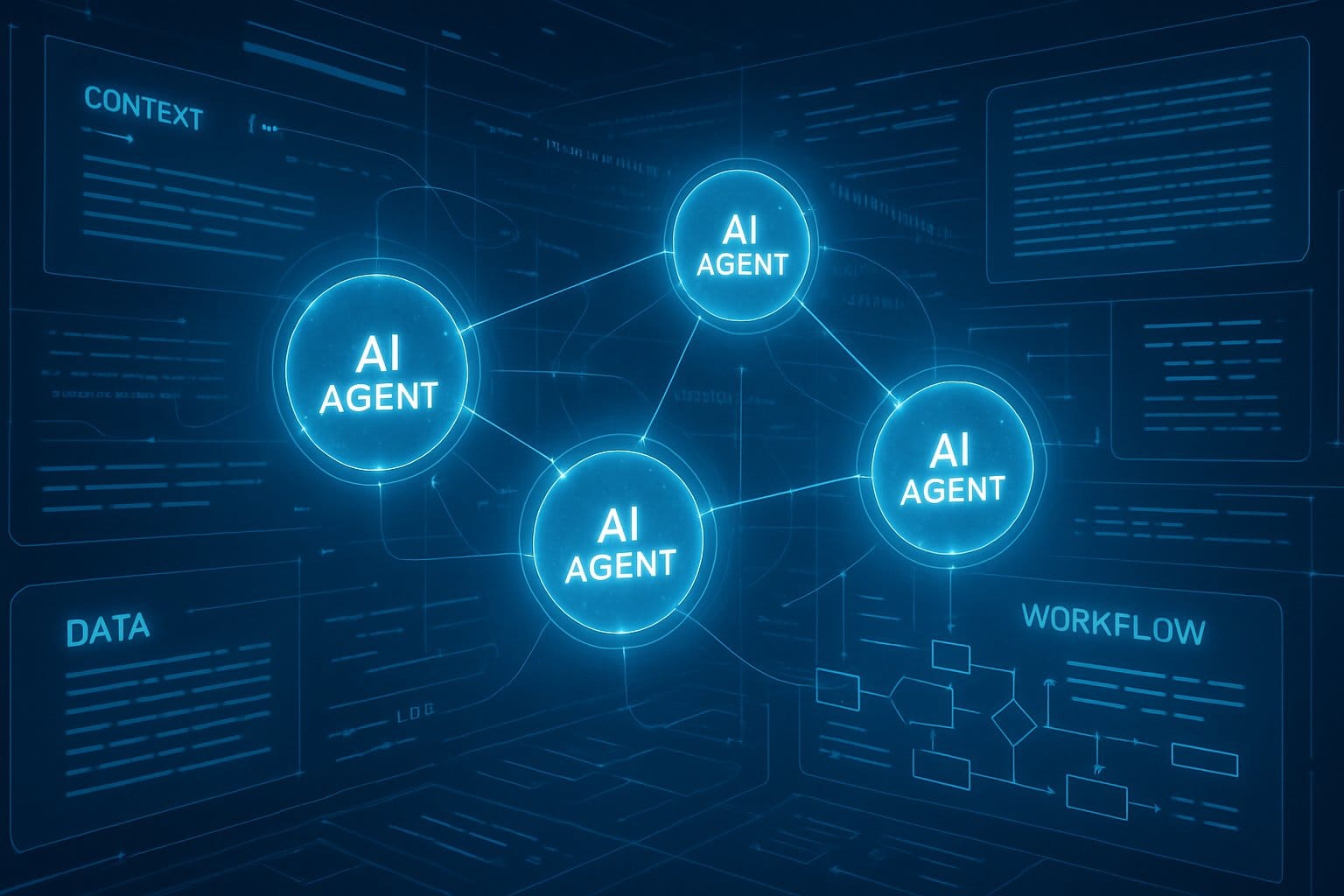
It is especially important for long-lived agents. Anthropic highlights that agents performing tasks over tens of minutes or even several hours can be prone to context window constraints, making compaction, note-taking, and multi-agent systems increasingly applicable.

Prompt Engineering vs Context Engineering
There is a close connection between prompt engineering and context engineering, although they address different issues.
Prompt engineering poses the following question:
"How should I formulate the prompt?"
While context engineering poses the following question:
"What is the full information context that the model should get in order to carry out this task successfully?"
The prompt may instruct an AI agent to "review the customer's account and suggest the next step."
Context engineering will decide on what information context will be provided along with the prompt to the agent: account history of the customer, current subscription, past support exchanges, relevant policy, available tools, permissions, and maybe some company policies.
Hence, a perfect prompt can lead to unsatisfactory output if the context around it is inappropriate.
Rather than replacing prompt engineering, context engineering should be viewed as its natural extension for increasingly complex AI systems.
Why Context Engineering Matters More for AI Agents
The fundamental difference is state.
A conventional LLM interaction may involve one input followed by one output. An agent, on the other hand, can follow a loop:
Goal → Reason → Use Tool → Observe Result → Update Context → Reason Again → Act
Anything that occurs can provide new information. Search results, API responses, data stored in databases, errors from tools, or clarification from users can affect how the agent proceeds.
Therefore, a developer cannot just design a single ideal prompt for the entire workflow process because it would not stay consistent for the whole process.
That is the reason why AI agent context engineering revolves around constantly curating the information that the model has access to.
For instance, let us consider an AI software development company agent designed to migrate a legacy application. It will require:
- The original migration objective
- Repository structure
- Coding standards
- Dependency information
- Previous modifications
- Test results
- Error logs
- Deployment requirements
However, not every piece of information needs to remain in active context indefinitely. Old debugging output may become irrelevant, while a critical architectural decision may need to persist.
The engineering challenge is therefore not simply storing information. It is deciding what information deserves attention at each stage of execution.
The Core Components of LLM Context Engineering
- Information Selection
The first phase would involve determining which data must be input into the model.
Rather than feed an entire knowledge base, an agent can simply extract data that pertains to the task at hand, which can eliminate redundant tokens.
- Information Retrieval Augmented Context
Through retrieval-based systems, the agents are able to access any external data needed, such as:
- Customer records
- Product documentation
- Internal policies
- Previous support tickets
- Current pricing information
The retrieved information can then become temporary context for the model.
- Context Compaction
Over time, agents may store more information than is needed or possible within the active context window.
Context compaction is the process of compressing past interactions and retaining only that information which is still relevant.
Anthropic explicitly states that compaction is one way of making it possible for agents to work through long tasks without growing context too much.
- Structured Memory
Not all information needs to be stored in the same manner.
Short term state is used to store the current task whereas longer term memory can hold permanent information such as user preferences, decisions for a project or knowledge for an organization.
This differentiates active context from persistent memory.
- Tool Context
More and more often, AI agents depend on tools in order to interact with external systems. Definitions of those tools, permission settings, API calls, and their execution history all influence future decisions.
For instance, new features in the OpenAI 2026 Agents SDK allow agents to examine files, execute commands, edit code, and do other more lengthy tasks within sandboxes.
Context Engineering Is Not About Putting Everything Into the Context Window
A common misconception is that larger context automatically creates smarter agents.
In practice, excessive context can become counterproductive.
Anthropic's engineering guidance recommends finding the smallest useful set of high-signal tokens rather than indiscriminately maximizing the amount of information provided to the model.
Consider an AI customer-service agent handling a refund request. Giving it the customer's entire five-year interaction history may sound useful. However, if the current request only requires the latest order, refund policy, and recent support interaction, the additional information could introduce noise.
Therefore, effective context engineering involves three questions:
What should be included?
What should be excluded?
What should be updated between agent steps?
This makes context management an optimization problem involving relevance, latency, cost, accuracy, and reliability.
Context Engineering and Agent Reliability
Context engineering is also connected with AI safety to a significant degree.
The more autonomous the agent, the more serious will be the effects of context errors. The agent will take the wrong decision if it receives outdated permissions, incorrect information from the tools, or wrong instructions.
As mentioned in the 2026 Anthropic report, increasing autonomy of agents raises problems for governance because the agents operate with decreased human control and can be subjected to various threats, such as prompt injection.
Thus, the context cannot be considered as a source of unlimited information.
Production systems should consider:
- Access control
- Data provenance
- Context validation
- Sensitive-data filtering
- Tool authorization
- Audit logging
- Prompt-injection defenses
- Human approval for high-impact actions
In other words, context engineering is increasingly becoming part of AI governance and security architecture.
How Businesses Can Apply Context Engineering
Context engineering is relevant across many enterprise applications.
Customer Support Agents
Agents could potentially utilize customer history, product manuals, account details, and organizational policies to generate more informed answers.
Coding Agents
Coding agents can leverage repository organization, code standards, issue descriptions, testing results, and previously made changes to ensure consistent development of all software products.
Financial Agents
Financial processes could potentially grant access to transactions, compliance rules, customer profiles, and authorization boundaries to agents while keeping any other irrelevant information inaccessible.
Research Agents
Research agents could be capable of automatically sourcing materials, summarizing research findings, managing research notes, and deleting irrelevant intermediate data during the course of the task.
Knowledge Agents for Enterprises
Internal assistants using artificial intelligence could utilize organizational documentation, permissions, user context, and business information to give relevant answers.
If you're developing an agentic system, a better place to start than with a long prompt would be a context map, which outlines all possible sources of information for your agent, as well as their availability and duration.
A Practical Context Engineering Framework for 2026
Organizations can approach context engineering through a simple five-stage framework:
- Define the Objective of the Agent
Explicitly state the objective of the agent and the decisions it must take.
- List the Available Context
State system instructions, user inputs, tools, databases, documents, memory, and external data sources available.
- Rate the Importance of Information
Rank the importance of information as critical, useful, transient, or irrelevant for each stage in the process.
- Define Context Updates
Define context changes that occur due to tool invocations, user inputs, completion of subtasks, errors, and major decisions.
- Evaluate Agent Performance
Use datasets and production metrics to decide whether context changes improve the agent's performance.
This stage is especially crucial as changes in the context strategy may affect agent behavior. According to Anthropic, 2026 guide on agent evaluations, systematic evaluations help to observe behavioral changes before moving into production phase.
What's New About Context Engineering in 2026?
The biggest change is that context engineering is moving from an experimental technique toward a core architectural discipline for agentic AI.
Three developments are particularly important.
Agentic Systems Are Becoming Longer-Running
AI agents increasingly perform tasks across multiple steps rather than responding once. This makes state management and context compression essential.
Tool Use Is Expanding
Agents can now interact with files, APIs, databases, browsers, development environments, and other software systems. Each interaction generates additional context that must be managed.
Context Is Becoming Dynamic
Modern agents do not operate from a static prompt. Their information environment changes throughout execution.
Anthropic's 2026 work on Claude Code illustrates this evolution. The company reported removing more than 80% of Claude Code's system prompt for newer Claude 5 models and emphasized that the effective context includes system instructions, Skills, project files, memory, and other sources.
This demonstrates a broader principle: as models become more capable, developers increasingly need to focus on providing the right context rather than simply adding more instructions.
The Relationship Between AI Agents and Context Engineering
The future of AI agents and context engineering is closely connected.
Agents need context to understand their environment, while context engineering determines what the agent is capable of understanding at each stage of execution. Therefore, improving an agent is not always about selecting a more capable model.
Sometimes the better solution is:
- Better retrieval
- Cleaner tool outputs
- More precise memory
- Better state representation
- Smarter summarization
- Stronger permission boundaries
- More effective context filtering
This is an important architectural shift. Model intelligence and system intelligence are not exactly the same thing.
A highly capable model operating with poor context can still make unreliable decisions. Conversely, a well-engineered context pipeline can allow a model to perform substantially better on a defined workflow.
The Future of LLM Context Engineering
As AI systems become more autonomous, LLM context engineering will likely become increasingly connected with retrieval architecture, memory systems, agent orchestration, observability, evaluation, and security.
The future is therefore unlikely to be about creating one enormous prompt.
Instead, production AI systems will increasingly assemble context dynamically according to the agent's objective, current state, available tools, user permissions, and previous actions.
The guiding principle is simple:
“Context is a critical but finite resource for AI agents.” — Anthropic
That principle captures the central challenge of agentic ai consulting company. More information is not necessarily better information. The objective is to provide the model with the right information, at the right time, in the right structure.
Evaluate context quality, retrieval accuracy, memory, and state management before adding tools, autonomy, or larger models.
Final Thoughts
From prompt engineering to context engineering for AI agents is also indicative of a more widespread transformation in the process of building AI. While prompt design still plays an important role, it is a part of a much bigger picture.
As AI agents start performing multi-step processes, interfacing with other systems, and running for a longer period of time, developers have to build up the entire context around the model.
By 2026, the competitive edge will be gained by companies building AI systems which will know not only how to respond, but what information to take into account, which to disregard, which to memorize, and when to take action — supported by a reliable custom software solutions company that can build and integrate these intelligent systems.
And for companies looking into building agentic AI, context engineering is something which has to be thought of in the design stage rather than when the agent starts delivering erroneous output.
FAQs
What is context engineering for AI agents?
Context engineering for AI agents is the process of designing and managing the information supplied to an AI model throughout an agent's execution. It can include instructions, memory, retrieved data, tool outputs, conversation history, application state, and permissions.
How is context engineering different from prompt engineering?
Prompt engineering focuses primarily on creating effective instructions for a model. Context engineering takes a broader approach by managing the complete information environment available to the model at each stage of an agent's workflow.
Why is context engineering important for AI agents?
AI agents perform multi-step tasks and continuously generate new information. Without effective context management, agents can lose important information, become distracted by irrelevant data, exceed context limits, or make decisions based on outdated information.
Does a larger context window eliminate the need for context engineering?
No. A larger context window provides more capacity, but it does not guarantee that all available information is relevant. Context engineering remains necessary to select high-value information and reduce context pollution.
What technologies are used in AI agent context engineering?
Common technologies include retrieval-augmented generation, vector databases, memory systems, context compression, structured state management, tool orchestration, observability platforms, and evaluation frameworks.
Can context engineering reduce AI costs?
It can. By retrieving and transmitting only relevant information, systems may reduce unnecessary token consumption and inference overhead. However, the actual savings depend on model pricing, architecture, retrieval strategy, and workload characteristics.
Is context engineering relevant to enterprise AI?
Yes. Enterprise AI agents often need access to multiple systems, internal documents, databases, APIs, and user-specific information. Context engineering helps determine which information an agent can access and use during each task while supporting security and governance requirements.
Will prompt engineering become obsolete?
No. Prompt engineering will remain an important part of AI development. However, as AI systems become more agentic and stateful, prompt design will increasingly become one component of a broader context-engineering discipline.


