
How Agentic AI Will Change Enterprise Software and Automation
Discover how Agentic AI is transforming enterprise software and automation with smarter workflows, faster decisions, and scalable efficiency.

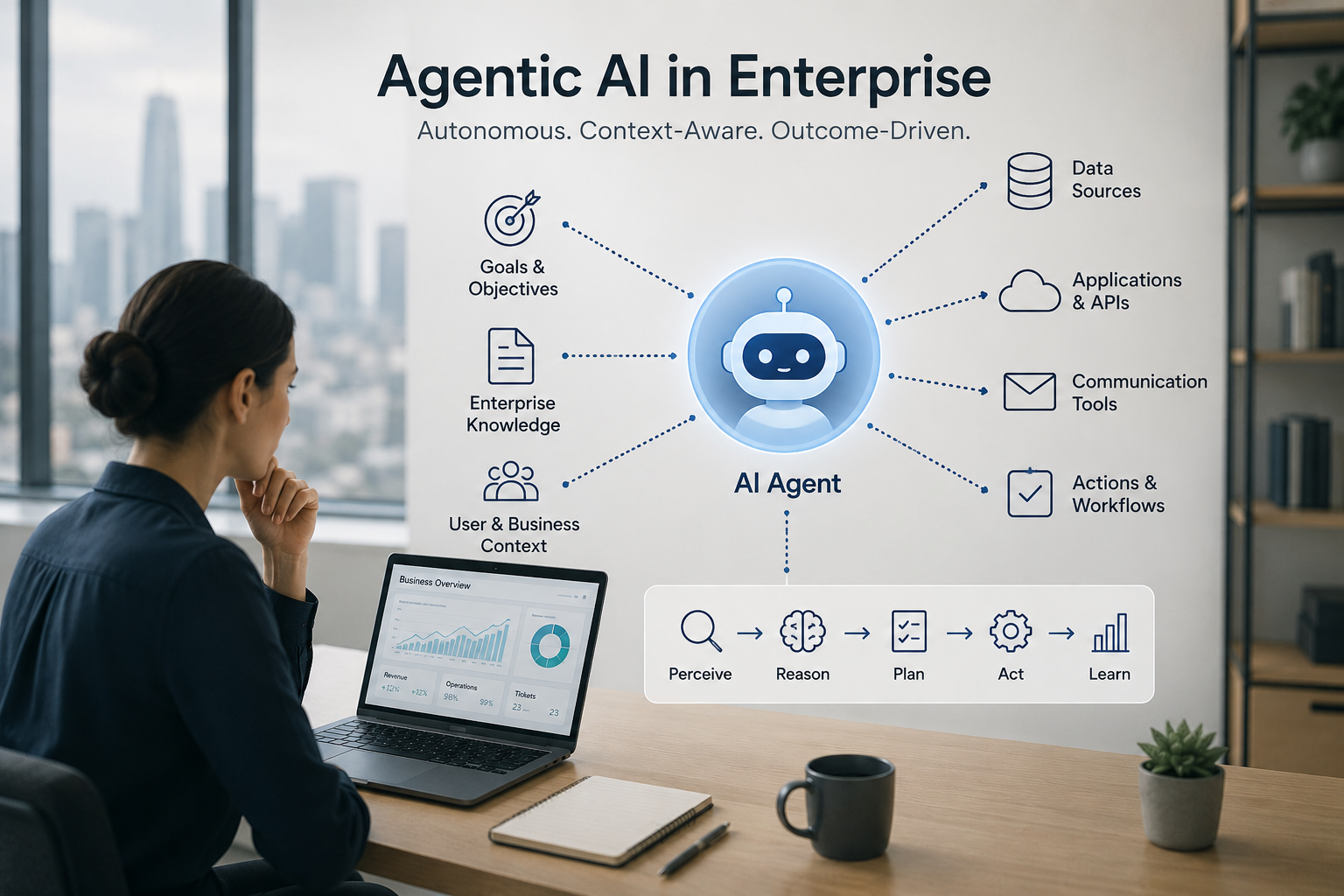
By 2026, enterprise tech will move from command-based systems to those that take actions and make decisions on their own. This evolution will be enabled by agentic AI – a new approach whereby software systems aren’t passive instruments but autonomous digital employees capable of executing complex multi-step business processes.
Industry predictions indicate that businesses embracing agentic AI early enough will see their costs of operation cut by up to 30-45% via automation of complex workflows that used to require human intervention. In the course of enterprise digital transformation, the requirements for enterprise software development services are undergoing rapid changes, with businesses now seeking advanced AI-powered platforms that can operate independently.
At Sobonix, we develop innovative digital solutions and platforms by means of custom enterprise software development services. We enable companies to implement agentic AI at every stage of business operation, workflow automation, and decision-making. In this blog post, we explore the emerging role of agentic AI in enterprise software development and automation.
Understanding Agentic AI in Enterprise Context
- Agentic AI is described as the ability of a system to independently:
- Understand its goals
- Break them down into smaller tasks
- Perform workflows between different systems
- Leverage outcomes
- Optimize strategies in real-time
While most conventional artificial intelligence systems are prompted at every single task, agentic systems function like independent agents within predetermined business ecosystems.
Within enterprise software, this implies a departure from simple dashboard tools and automated procedures to goal-oriented platforms that control workflows.
Example:
- Rather than simply alerting about issues, an agentic system would be able to explore why they happened
- Instead of creating reports, it would be able to interpret and deliver recommendations
- Instead of asking for instructions from users, it would take proactive measures across connected systems
This completely transforms how custom enterprise software solutions are developed.
Why Agentic AI Is Emerging Now
A few technologies are coming together that will help create agentic AI on an enterprise scale:
- Evolution of Large Language Models
New LLMs are capable of reasoning, planning, and acting out multiple steps with greater consistency.
- Ecosystems of APIs
Entire enterprise systems today have strong integration via APIs, facilitating automation across systems.
- Scalable Cloud Infrastructure
Agentic systems require scalable cloud infrastructure to ensure consistent AI behavior without performance bottlenecks.
- Orchestration Tools
Memory management, workflow orchestration, and state retention tools ensure continuity of behavior over time.
These technologies are coming together to build a new kind of system for which traditional enterprise software development services were not intended.
How Agentic AI Is Transforming Enterprise Software
- From Workflows Automation To Workflow Execution Based On Autonomy
Classic automation is rule and script-based. In case of agentic AI, decisions regarding how particular workflows shall be executed emerge on the fly.
For example, within procurement software:
A classic system issues alerts regarding inventory shortages
An agentic system analyzes demand, initiates dialogue with suppliers, negotiates schedules for delivery of new orders, updates inventory in ERP. Such a degree of autonomy significantly reduces human intervention and speeds up processes.
- Intelligent Decision Making In Enterprises
Traditionally, corporate software was rich in data but poor in insights. Agentic AI resolves the issue by constantly analyzing data and making decisions within set boundaries.
For example, in the case of financial software:
- It monitors transactions
- Identifies anomalies
- Changes risk parameters
- Triggers compliance workflow
- As a result, enterprise software is transformed from data-reporting solutions into decision-making systems.
- Self-Optimizing Corporate Applications
Perhaps, one of the most useful characteristics of agentic AI is self-improvement. Instead of executing a particular action as scripted, enterprise software starts learning over time.
For example:
CRM solutions automatically optimize lead scoring models
HR platforms optimize workflows based on successful previous hiring cases
SaaS software suggests features to customers based on behavioral
4. Cross-System Orchestration
Modern enterprises rely on multiple disconnected tools. Agentic AI acts as a unifying layer that coordinates actions across systems such as:
- CRMs
- ERPs
- SaaS platforms
- Internal databases
Instead of switching between tools, enterprises can deploy agents that execute end-to-end processes seamlessly.
For example, a sales order process could involve:
- CRM validation
- Inventory check in ERP
- Invoice generation
- Customer notification
All executed autonomously by agentic systems.
5. Human-AI Collaboration Models
Agentic AI does not eliminate human roles; instead, it reshapes them. Employees transition from task execution to supervision and strategic decision-making.
In enterprise environments:
- Humans define goals and constraints
- AI agents execute operational workflows
- Humans validate outcomes and refine strategies
This creates a collaborative ecosystem where productivity is significantly amplified.
Advantages of Agentic AI in Enterprise Software and Automation
The emergence of agentic AI is changing enterprise software from responsive solutions to intelligent and autonomous business environments. The first advantage offered by such technology is enhanced efficiency. With agentic AI being capable of handling repetitive tasks and solving complex problems without human intervention, businesses can increase their productivity while performing more important functions.
Moreover, agentic AI allows businesses to make better decisions by processing information, analyzing outcomes, and suggesting appropriate actions. Such advantages allow companies to respond to market dynamics and customers' needs immediately.
Scalability is another benefit provided by agentic AI. When using automated processes for addressing new problems, business owners do not need to employ additional people for handling these problems. Another aspect related to this issue is that autonomous solutions provide greater interoperability, interacting with CRMs, ERPs, cloud computing, and other business tools.
Agentic AI improves the performance of business operations significantly. Businesses can become more intelligent and adaptive while minimizing operational costs at the same time.
Role of Enterprise Software Development Services in the Agentic Era
With agentic AI on the rise, the concept of enterprise software development services is getting broader and consists of:
- AI-first architectural design
- Agent orchestration platform creation
- Integration across multiple system workflows
- Inclusion of decision intelligence in applications
- Implementation of governance and control mechanisms.
Standard software development will not be enough anymore. The companies will need developers who can create intelligent systems integrating all these elements.
Custom Enterprise Software Development in the Age of AI Agents
The emergence of agents as part of artificial intelligence is revolutionizing the entire process of enterprise application development.
Whereas previously the aim was to develop fixed programs, the new way involves developing:
- Agent-capable frameworks
- Systems driven by events
- Ecosystems with an API-first mentality
- Layers for orchestrating AI
- Memory-capable software
In Sobonix, this results in enterprise applications that are not only functional but self-adaptive and autonomous.
For instance, within a logistics application:
- Agents could track delivery statuses
- Forecast potential delays
- Alter delivery routes
- Automatically notify all parties involved
Challenges in Implementing Agentic AI
The potential of agentic AI notwithstanding, some difficulties emerge:
1. Governance and Control
Autonomous agents need to be kept inside certain parameters of their operation within the business.
2. Security
Due to the nature of such agents, access to many enterprise systems will be necessary.
3. System Integration
Integration with legacy systems may become difficult due to incompatibility with such technology.
4. Dependability and Precision
Decisions made by agents must always be precise, consistent, and verifiable.
These challenges can be overcome through proper architectural design and custom enterprise software development experience.
Future of Enterprise Automation with Agentic AI
Over the next few years, enterprise automation will evolve into fully autonomous ecosystems where:

- Software systems coordinate with each other
- AI agents handle operational workflows
- Human oversight becomes strategic rather than operational
This shift will redefine productivity, scalability, and operational efficiency across industries.
Enterprises that invest early in agentic AI will gain a significant competitive advantage by building self-operating digital infrastructure.
How Sobonix Enables Agentic AI Transformation
Sobonix supports enterprises in adopting agentic AI through:
- AI-native architecture design
- Scalable enterprise software development services
- Integration of autonomous agents into existing systems
- Secure and compliant AI deployment frameworks
- End-to-end custom enterprise software development solutions
Our approach ensures that enterprises can transition from traditional software systems to intelligent, autonomous ecosystems without disrupting existing operations.
Final Thoughts
Agentic AI represents a major turning point in the evolution of enterprise software. It shifts systems from being reactive tools to proactive digital agents capable of managing complex business operations autonomously.
As organizations modernize, the role of enterprise software development services is expanding to include AI-driven orchestration, automation intelligence, and autonomous workflow execution.
With expertise in custom software development services, Sobonix helps businesses build future-ready systems that are not only efficient but intelligent, adaptive, and scalable in a rapidly evolving digital landscape.
FAQs
What is agentic AI in enterprise software?
Agentic AI refers to systems that can independently plan, decide, and execute tasks across enterprise workflows without constant human input.
How is agentic AI different from traditional automation?
Traditional automation follows fixed rules, while agentic AI dynamically adapts, reasons, and executes multi-step workflows.
Which industries benefit most from agentic AI?
Industries like finance, logistics, healthcare, SaaS, and manufacturing benefit the most due to complex workflows and large-scale operations.
Does agentic AI replace enterprise software?
No. It enhances enterprise software by adding intelligence, autonomy, and decision-making capabilities.
Why choose Sobonix for enterprise AI development?
Sobonix specializes in custom enterprise software development and AI integration, delivering scalable and intelligent systems designed for modern enterprise needs.


