
Best Tech Stack for SaaS Development in 2026: A Complete Guide for Building Scalable Applications
Discover the best SaaS tech stack for 2026 and learn how to build secure, scalable, and high-performance applications faster.
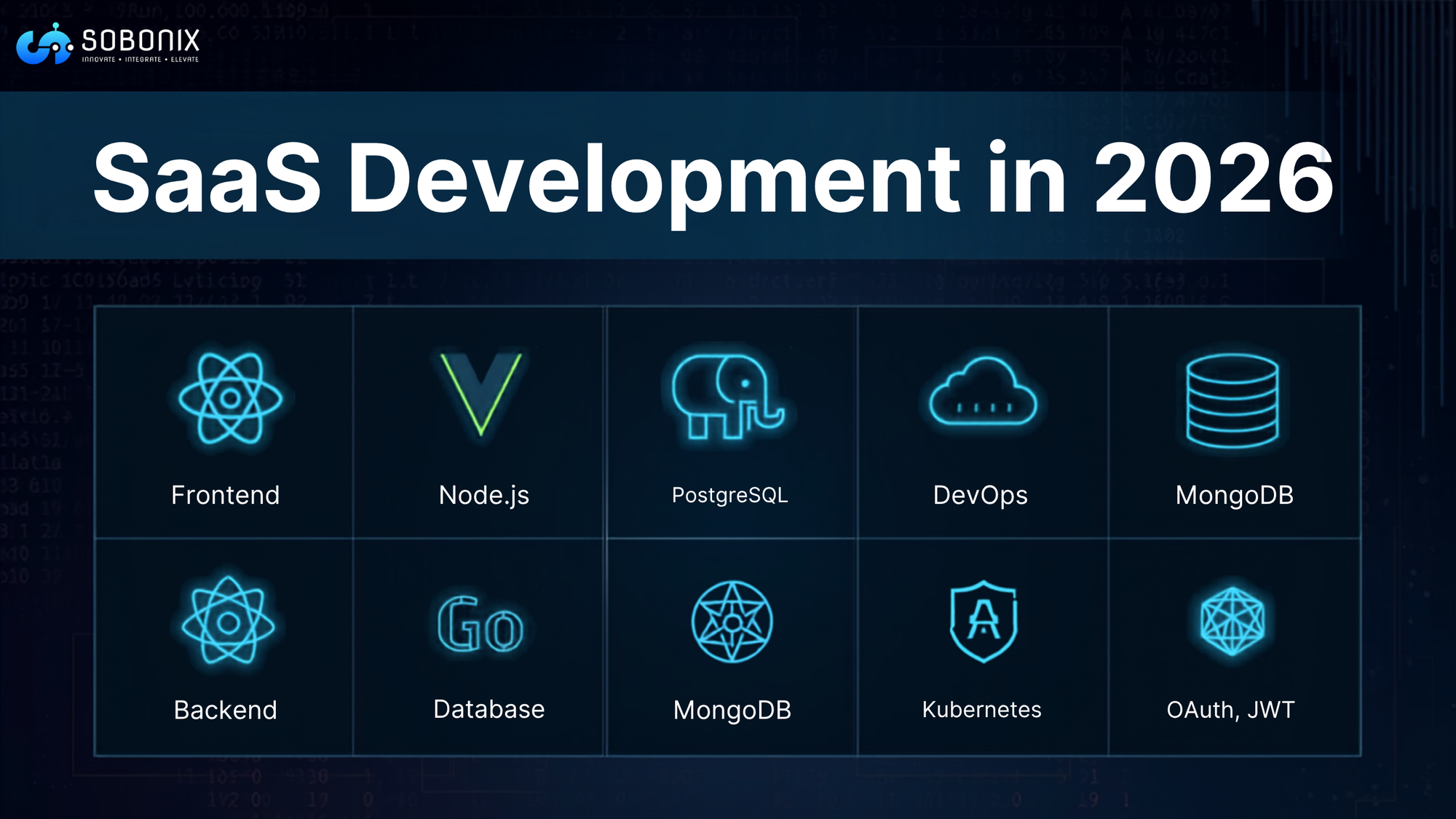
The SaaS industry is continuously reinventing the way businesses acquire software. From project management solutions, fintech solutions, health-tech systems to AI-based business solutions, Software as a Service becomes the leading delivery method in modern digital products.
But the success of any SaaS application becomes increasingly difficult amid rising competition. The first step to ensuring your SaaS application performs well is choosing the right set of SaaS technologies. The technologies utilized during development will determine the overall performance, scalability, security, user experience, maintenance costs, and growth potential of the product.
Sobonix develops scalable SaaS applications for startups and enterprises to meet changing customer demands. This guide discusses some of the best technologies, frameworks, and architecture types used in SaaS applications in 2026 based on recent technology trends and market requirements.
Why Your SaaS Tech Stack Matters More Than Ever
A technology stack is the collection of programming languages, frameworks, databases, infrastructure tools, and development environments used to build and operate a software application.
For SaaS businesses, selecting the right stack is particularly important because the application must support:
- Thousands or even millions of users
- Continuous feature releases
- Multi-tenant environments
- Secure data management
- High availability
- Third-party integrations
- Growing infrastructure demands
Consequently, poor technology choices can lead to performance bottlenecks, technical debt, and rising operational costs. Meanwhile, a well-designed scalable SaaS architecture provides the flexibility needed to support long-term business growth.
SaaS Market Growth Driving Technology Innovation
The global SaaS market continues to expand rapidly. Industry reports estimate that the SaaS sector will surpass $400 billion in market value by the end of the decade. Additionally, enterprise spending on cloud-based software continues to rise as organizations prioritize digital transformation and operational efficiency.
This growth is encouraging SaaS providers to adopt modern development frameworks, cloud-native infrastructure, AI capabilities, and microservices-based architectures to remain competitive.
As a result, the SaaS technology landscape in 2026 looks significantly different from what it was just a few years ago.
Key Components of a Modern SaaS Tech Stack
- A typical successful SaaS application should be built on various layers which are interconnected together:
- Frontend Development Layer
- Frontend development is aimed at providing users with an excellent experience in all web browsers and devices.
- Examples of commonly used frontend frameworks/libraries:
- React.js
- React framework is still widely popular among developers because of its component-oriented approach and performance optimization features.
- Pros:
- Quick rendering process
- Component reuse
- Rich ecosystem of developers
- Good scalability
- Next.js
- For SaaS apps that require SEO optimization and server-side rendering, Next.js will be the framework to use.
Pros:
- Faster page load
- SEO optimized pages
- Deployment flexibility
Backend Technologies for SaaS Application Development
The backend manages business logic, APIs, authentication, and database interactions.
Node.js
Node.js remains a leading choice for SaaS application development company due to its event-driven architecture and ability to handle high-concurrency workloads.
Advantages include:
- Fast performance
- Efficient API handling
- Large ecosystem
- Excellent scalability
Python
Python continues to dominate applications involving machine learning, automation, and AI integrations.
Popular frameworks include:
- Django
- FastAPI
- Flask
These frameworks enable rapid development while maintaining security and scalability.
Golang
Many enterprise SaaS companies are increasingly adopting Golang for backend services because of its speed and efficient resource utilization.
Golang is particularly effective for:
- High-performance APIs
- Microservices
- Real-time applications
- Large-scale distributed systems
Database Technologies for Scalable SaaS Architecture
Choosing the right database is critical for performance and growth.
PostgreSQL
PostgreSQL remains one of the most trusted relational databases for SaaS products.
Benefits include:
- Reliability
- Strong security features
- Advanced indexing
- Scalability support
MongoDB
For applications managing large volumes of unstructured data, MongoDB provides flexibility and horizontal scalability.
Common use cases include:
- Content management platforms
- Analytics systems
- Customer engagement applications
Redis
Redis is commonly used as an in-memory database for:
- Caching
- Session management
- Real-time processing
Its implementation significantly improves application performance.
Also Read : How to Add AI Features to Existing Software Applications in 2026
Cloud Infrastructure for SaaS Platforms
Modern SaaS businesses rely heavily on cloud infrastructure.
Amazon Web Services (AWS)
AWS continues to lead the cloud market due to its extensive service ecosystem and enterprise-grade reliability.
Popular AWS services include:
- EC2
- Lambda
- RDS
- ECS
- S3
Microsoft Azure
Azure remains a preferred choice for organizations operating within Microsoft ecosystems.
Google Cloud Platform (GCP)
GCP offers strong support for AI workloads, analytics, and cloud-native development.
Microservices: The Foundation of Scalable SaaS Architecture
Monolithic architectures are often found lacking when scaling up SAAS applications.
Many companies are thus adopting microservices architecture in their application designs.
- With microservices, software architects will be able to:
- Deploy services independently
- Scale services independently
- Achieve better fault isolation
- Develop faster
Microservices have emerged as an integral part of modern scalable SAAS architecture.
AI Integration: A Must-Have for SaaS Products in 2026
Artificial intelligence is increasingly turning into an expected rather than an additional component.
The expectations of today’s SaaS users have become increasingly demanding:
- Smart recommendations
- Predictive analysis
- Conversational user experience
- Workflow automation
- Popular AI-powered solutions deployed within SaaS platforms:
- APIs by OpenAI
- Models by Anthropic
- Machine learning stacks
- Vector databases
- AI agents
It becomes obvious that the AI capabilities can play a decisive role in SaaS adoption and user retention.
DevOps and CI/CD Technologies
Continuous delivery has become essential for SaaS success.
Popular DevOps tools include:
Docker
Docker simplifies application packaging and deployment across environments.
Kubernetes
Kubernetes enables container orchestration, workload scaling, and service management.
GitHub Actions
Development teams use GitHub Actions to automate testing, deployment, and monitoring processes.
Together, these tools improve development efficiency and system reliability.
Security Considerations in SaaS Development
Security remains one of the most important factors in SaaS application development.
Key security components include:
Identity and Access Management
Authentication technologies include:
- OAuth 2.0
- OpenID Connect
- Multi-factor authentication
Data Encryption
Sensitive customer information should be protected through:
- Encryption at rest
- Encryption in transit
- Secure key management
Compliance Frameworks
Depending on industry requirements, SaaS products may need compliance with:
- GDPR
- HIPAA
- SOC 2
- PCI DSS
A robust security framework strengthens customer trust and reduces operational risks.
Emerging SaaS Development Trends in 2026
When companies are considering their SaaS technology roadmap, they may want to examine the current trends.
AI-First SaaS Platforms
Many new SaaS services are designed using an AI-first approach, rather than integrating AI features.
Low-Code Development Speedup
Low-code development systems can help accelerate developers’ work inside organizations and create prototypes more efficiently.
Multi-Cloud Strategy
Companies can adopt multi-cloud approaches to avoid relying on a single cloud provider and ensure high reliability.
Edge Computing
With edge computing, businesses can achieve quicker processing times and less latency for remote users.
Serverless Computing Approach
Serverless architecture helps to minimize operational costs while making processes scalable.
How to Choose the Right SaaS Tech Stack
Selecting the ideal technology stack depends on several factors.
Businesses should evaluate:
- Product complexity
- Expected user volume
- Security requirements
- Budget constraints
- Development timelines
- Future scalability goals
Instead of following trends blindly, companies should align technology decisions with business objectives and long-term growth plans.
Why Businesses Partner with Sobonix for SaaS Application Development
We recognizes that each SaaS solution has its own needs from both technical and business perspectives.
- In SaaS development, our priorities include:
- Architecture design scalability
- Cloud-based development
- Ability to integrate with artificial intelligence
- High-end security
- Maintainability
We are ready to assist companies in creating their SaaS solutions that will be able to cope with further developments.
Final Thoughts
However, the effectiveness of the entire SaaS product starts with choosing the most suitable technological base. Given the continuous change in consumer preferences and increasing complexity of software environments, companies should consider flexibility, performance, and scalability while choosing an appropriate SaaS technology stack.
Everything from frontend technologies to cloud computing and even artificial intelligence integration is part of what makes the development of a successful SaaS product possible. Companies investing in such a future-ready scalable SaaS solution can be sure of achieving success in the future.
By relying on professionals specializing in SaaS based product development company such as Sobonix, companies are bound to benefit greatly.
FAQs
What is a SaaS tech stack?
A SaaS tech stack refers to the collection of technologies, frameworks, databases, infrastructure tools, and programming languages used to build and maintain a SaaS application.
Which frontend framework is best for SaaS application development in 2026?
React.js and Next.js remain among the most popular choices due to their performance, scalability, and strong ecosystem support.
Why is scalable SaaS architecture important?
A scalable SaaS architecture enables applications to handle increasing users, workloads, and features without compromising performance or reliability.
Which cloud platform is best for SaaS products?
AWS, Microsoft Azure, and Google Cloud Platform are all strong options. The best choice depends on business requirements, infrastructure needs, and development goals.
Should SaaS platforms integrate AI features?
Yes. AI capabilities such as automation, predictive analytics, chatbots, and intelligent recommendations are becoming key differentiators in the SaaS market.
What database is best for SaaS applications?
PostgreSQL is often preferred for structured data, while MongoDB is suitable for unstructured data and high-flexibility applications.
How does Sobonix help with SaaS application development?
We provide end-to-end SaaS application development services, including architecture design, frontend and backend development, cloud deployment, AI integration, security implementation, and ongoing optimization.


